
L is for…
Language.

I’m proud of my heritage, proud to be Scottish. But sometimes finding the right english word is a nuisance…..
L is for…
Language.
I’m proud of my heritage, proud to be Scottish. But sometimes finding the right english word is a nuisance…..
K is for….
Kingdom

I’m a big history nerd, I admit it! The history of Scotland is close to my heart. I love it.
(sourced)
By the end of the seventh century, the four kingdoms of Alban were united in the Christian faith, but not much else.
Even the constant raids of the Norsemen, beginning in the eighth century and culminating in the conquest of Orkney, Shetland, the Western Isles, Caithness and Sutherland, (where, in many areas, the non-Celtic Pictish tongue was replaced by the Scandinavian Norn), could not bring the four kingdoms together in a common cause.
Picts and Scots, with their own separate languages, were still enemies; and the Welsh-speaking Britons of Strathclyde were desperately trying to hold on to their culture in the face of ever-increasing hostility from the Angles of Lothian and Northumbria.
A semblance of unity among the warring societies of the Picts, Scots, Britons and Angles did eventually arrive, however, by the year 843, thanks to the determined efforts of Kenneth MacAlpin, King of the Scots of Dalriada, who claimed the throne of the Picts after he had defeated them in battle. He created his capital at Forteviot, in Pictish territory; moved his religious center to Dunkeld, on the River Tay, in present-day Perthshire, where he transferred the remains of St. Columba from Iona.
According to the Huntingdon Chronicle, MacAlpin “was the first of the Scots to obtain the monarchy of the whole of Albania, which is now called Scotia.” From that time on, the Picts, the tattooed or painted people, have remained a shadowy, poorly documented race. It is a pity that no Pictish literature has survived. All we have are the sculptured stones with their remarkable designs incised that show warriors, huntsmen and churchmen.
In 1018, under MacAlpin’s descendant Malcolm II, the Angles were finally defeated in this northerly part of Britain and Lothian came under Scottish rule. In the same year, the British (Celtic) King of Strathclyde died leaving no heir; his throne went to Malcolm’s grandson Duncan. In 1034, Duncan became King of a much-expanded Scotland that included Pict-land, Scotland, Lothian, Cumbria and Strathclyde. It excluded large tracts in the north, the Shetlands, Orkneys and the Western Isles, which were held by the Scandinavians.
When David died in 1153, the kingdom of Scotland had been extended to include the Modern English counties of Northumberland, Cumberland and Westmoreland, territories that were in future to be held by the kings of Scotland.
At the Treaty of Perth, 1266, the Western Isles and the Isle of Man were ceded to Scotland.
Orkney and Shetland remained under the control of the Norwegians until 1468 when James II of Scotland married Margaret, daughter of Christian I of Denmark. Orkney and Shetland were part of the dowry. Further, in 1470, the Earl of Orkney resigned his territories in exchange for lands in Fife, thus giving James II all the lands and rights in the northern isles.
Scotland was very much a different place than it is today!

J is for…
Jie or Jay
The endless debate!
Where I come from the letter is pronounced Jie. Jay is not a letter but a name. It’s a Scottish thing!

I is for…
Ina
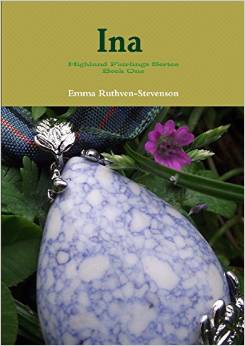
It really had to be, right?

H is for
Husband

Mine is called Mark. He is wonderful, helps proof read, type, suplies an endless stream of pens and paper.
In Scotland he carried my little dog to the top of a castle so she wouldn’t whine for me at the bottom.

He also tested and then described the feelings of every device/machine at the Crannog aswell as making sure I had brilliant, detailed photos.


Firstly I must inform that the only reason I have awarded a four and not five star is personal preferences. I’m new to the more erotic temperance of romance but if anyone could tempt someone to this genre it would be Nina Mason!!!!! She weaves an intricate tale that flows brilliantly and combines romance, erotica and a strong sense of fact.
Before any reveiw can even be contempated I must again tell you how much I appreciate the work that Nina puts in to her research. This is displayed not just in this book but in them all and each time I read work by her I am again overjoyed with the factual aspects.
Before any reveiw can even be contempated I must again tell you how much I appreciate the work that Nina puts in to her research. This is displayed not just in this book but in them all and each time I read work by her I am again overjoyed with the factual aspects.
With a beginning that introduces you to the varying heights of passion and life for Maggie and Robert you know instantly the tempo of the book. Within the first chapter alone you see passion, bravery, fear and love all combined in a spellbinding tapestry that points out the writers skill and the development of characters you already had the joy of falling in love with and are now further committed to.
Nina places importance not just on the well researched erotic practices but also describes to us the differences between the glitz of London society as opposed to the quiet of country living.
Speaking of the erotic passages, they are well thought out, well researched and fit fluidly into the tale woven.
With the introduction of Robert’s brother Hugh and his french bride we meet two moree characters who are explored in details which Nina is happily known for.
By the halfway point of the book your distaste towards the actions of the supposed ‘good’ brother, Hugh will leave you in disgust and yet I cannot help but be enthralled by the way the characters are so well thought out and portrayed.
The whole book focuses on a firm mixture of sex and punishment woven around the intricate love of both Maggie and Robert. The tale of the love between the newly weds is refreshing. Far from the ‘happy ever after’ this love portrays the realism of a real relationship, counting in arguments and distrust as well as the lighter feelings.
I’ll not spoil this story with details but allow me to tell you that the ending battles and further concerns for the couple leave you in a state of spellbinding anticipation for the next installment.
My overall opinion? Yes there is sex but seeing as how it is an erotic romance there was obviously going to be some. It is handled superbly with strong work having been placed in keeping it enjoyable to read and factually correct and informative. There is nothing offensive.
This installment also contains some upsetting scenes as Hugh’s deplorable actions against Maggie are told.
All in all this pleasurable tale is a definate reccomendation if you are interested in this genre. If you are easily offended by sexual natures then I wioiuld suggest that this erotic story is possibly not for you.
I would strongly reccomend this book and thank Nina for the pleasure of writing it for us all to enjoy.

F is for..

I hear you as you go, what? But it’s true.

Facebook has been a miracle for me. It allows me to communicate with fans. And it also set me up with many novelist friends. I wouldn’t have had the guts to push ahead without the wonderful people I’ve met and became friends with.

E is for Ebha.
The daughter of Alasdair and Ina, Ebha features as Book two’s heroine.

The above picture is how she looks in my mind, it’s how I imagine here when I’m writing.
She is a lot more complex a character than I initially thought. I’m really enjoying her story but it’s hard work!!

D is for….
Dreams

So as corny as it sounds that is exactly how it started for me with the Highland Fairling series.
I know people say it countless times but it really is how it all happened. I was at the top of Benmore, admiring the veiw, pretending to be healthy and basically praying my unfit body wouldn’t explode when the daydream of the initial battle came to me.
After that the imagry became the prologue for Book One of the Highland Fairling series and the rest built from there.

C is for Ceci!!
Ceci Giltenan
I actually found this book whilst searching for a factual book concerning the clan Ruthven. I bought it on a whim thinking it would pass an evening at some point.
I owned it for rather a while before attempting to read it.
But after a few pages I was hooked and couldn’t put it down, I have since re-read it about three more times, loving it and the depth of characters that Ceci Giltenan has created more and more each time.
You will be drawn into Katherine and Niall’s love story but you’ll also love the other characters you meet along the way. Little Tomas is very sweet, but I also desperately wanted to know more of Fingall, Tadhg, Turcuil and Father Colm. Maybe one day these characters may feature in more stories? You never know!
A big thank you must be said for Ceci Giltenan for her wonderful, heartfelt story that encompasses love, betrayals, action, adventure and suspense in the highlands of Scotland.
 Emma Ruthven-Stevenson